Push Pier Underpinning
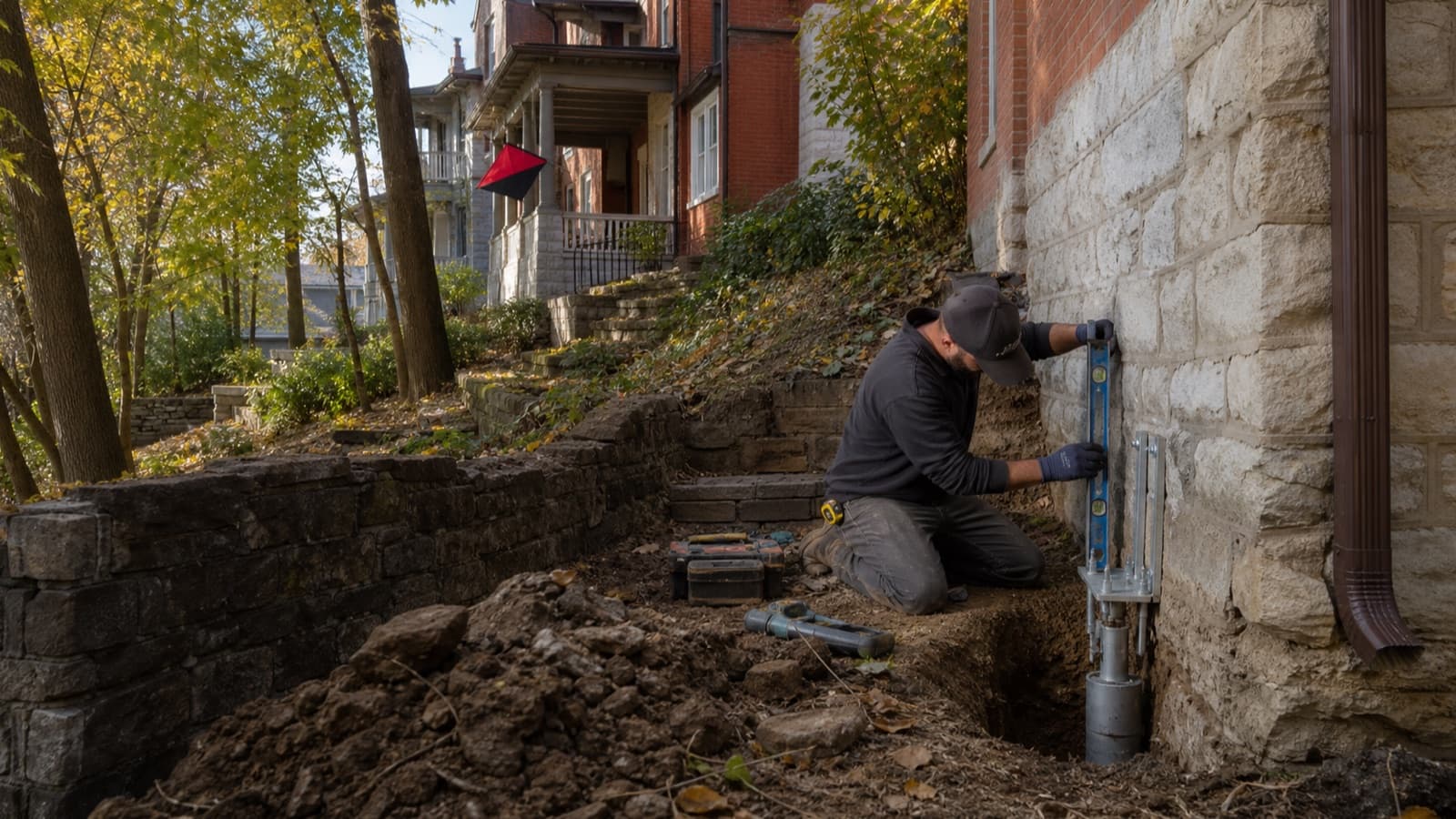
Steel push piers driven to load-bearing strata to stabilize and often lift a settling foundation.
Typical$1,200-$2,500 per pier; typical project $8,000-$25,000
Foundation repair across Greater Cincinnati and Northern Kentucky since 2016, performed by licensed, insured local contractors. Push piers, bowing-wall stabilization, and slab leveling scoped against a licensed engineer's recommendation. On-site inspection with floor-elevation measurements.
Step 1
Tell us what you are seeing: the cracks, the sticking doors, the bowing wall. A 10-minute call, no pressure, plain answers about whether it sounds cosmetic or structural.
Step 2
A specialist walks the home, measures floor elevations and wall deflection, identifies the cause and water sources, and explains your options. Structural scopes go to a licensed engineer for a stamped report.
Step 3
The contractor installs to the engineer's plan: push or helical piers, carbon fiber or steel beams, wall anchors, or slab leveling. Permitted where required, with the drainage work that keeps it lasting.
Step 4
You get the closeout package: the engineer's report, pier load tests, before-and-after elevations, and a transferable warranty that conveys to a future buyer and satisfies Ohio disclosure.
The Ohio River valley around Cincinnati is among the most landslide-prone regions in the United States, driven by Kope Formation shale.
Source: USGS Landslide Hazards
Typical Greater Cincinnati push pier underpinning project, with individual piers at $1,200 to $2,500 each.
Typical range across Greater Cincinnati pier projects since 2016
Expansive clay soils that swell and shrink with moisture are the leading driver of foundation movement in the region.
Engineer-backed pier systems carry transferable warranties that convey to the next owner, often for the life of the structure.
The Ohio River valley around Cincinnati is among the most landslide-prone regions in the country, with hillside slopes prone to creep and movement.
The Kope Formation shale and the region's expansive clay soils drive slope instability and foundation movement across Greater Cincinnati.
Industry standards of practice for foundation repair, pier installation, and wall stabilization.
Structural and geotechnical engineering standards that govern foundation design and repair.
The International Residential Code governs foundation construction, and ICC-ES evaluation reports verify pier system capacity and installation.
Ohio law requires sellers to disclose known foundation and structural defects to buyers.
Every job comes with a written quote and no-pressure consultation. Workmanship warranty terms are set by your lead technician and confirmed before work begins.
Steel push piers driven to load-bearing strata to stabilize and often lift a settling foundation.
Helical (screw) piers for lighter loads, porches, stoops, and new-construction support.
Carbon-fiber straps and steel I-beam bracing for bowing, cracked, or leaning basement walls.
Exterior earth anchors that pull a bowing basement wall back toward plumb over time.
Polyurethane foam jacking and mudjacking for settled slabs, garage floors, walkways, and steps.
Engineered epoxy and structural repair for cracked poured walls and footers.
We offer $150 off any foundation repair project for veterans, active military, first responders, and seniors 65 and older. Mention it when you call or request your inspection.
Mention this offer when you call
(513) 650-7437“Southeast corner had dropped about an inch and a half and the doors stuck. They measured everything, got an engineer's report, and installed push piers in three days. They also fixed the downspout that caused it. Floors are level and the paperwork was thorough.”
“Bowing block wall flagged ten days before closing. I was sure the deal was dead. They had an engineer spec it, installed carbon fiber and a drain in one day, and the documentation satisfied the buyer's lender. Saved the sale.”
“Two-year-old house in a subdivision, foundation settling on the fill. They explained it was under-compacted fill, brought an engineer, and underpinned with helical piers. Honest about what the builder warranty might cover too. Fixed price, no surprises.”
These reflect real situations from homeowners across our network. Names and some identifying details are adjusted to protect homeowner privacy while keeping the point of each story intact.
Greater Cincinnati sits on some of the most landslide-prone ground in the country. The USGS and the Ohio Geological Survey both document the Kope Formation, a weak, clay-rich shale that underlies much of the region and weathers into unstable colluvial soil on slopes. On the hillsides that define neighborhoods like Mt. Adams, Mt. Auburn, Price Hill, East Walnut Hills, and the Covington and Newport hillsides, that material slowly creeps downhill year after year, especially after heavy rain saturates it, pulling foundations apart laterally over time.
The soil chemistry compounds the slope problem. The region's expansive lacustrine and glacial-till clays swell when they take on water and shrink when they dry out, so foundations literally rise and fall with the seasons. A shallow footing can settle when a drought shrinks the clay beneath it, and a basement wall can bow when saturated clay swells against it. Freeze-thaw frost heave adds a third stressor every winter, lifting and dropping shallow footings, steps, and slabs as water in the soil freezes and expands.
Local construction history layers on top of the geology. Many pre-1940 Cincinnati homes have stone or early block foundations that were never engineered for these loads, and newer subdivisions in Mason, West Chester, and across Northern Kentucky are often built on graded fill that, if it was not properly compacted, keeps settling under the house for years. Across all of it, water is the common thread and the number one driver, which is why durable foundation repair in this region almost always pairs the structural fix with drainage and waterproofing.
Not every crack means a foundation problem, and a good contractor will tell you when something is cosmetic. The cracks and signs that point to genuine structural movement fall into two groups. Settlement signs, where the foundation is dropping, include stair-step cracks in brick or block that are wider at the top, diagonal cracks running from the corners of doors and windows, doors and windows that suddenly stick or gap at one corner, a chimney leaning away from the house, and floors that slope or feel bouncy. Lateral-movement signs, where a wall is being pushed in, include a horizontal crack across a block wall, a wall that visibly bellies inward, and stair-step cracks running toward the corners of a basement wall.
Cosmetic cracks, by contrast, are typically hairline, run vertically or randomly, do not grow over time, and show up in drywall or stucco rather than the structural foundation. They often come from normal concrete shrinkage in the first year or minor settling and usually need nothing. The reliable way to tell the difference between cosmetic and structural is to measure rather than guess: we map floor elevations across the home with a manometer or laser level to quantify settlement, and we measure wall deflection with a string line to quantify a bow.
For a questionable crack that is not clearly structural, the smart first step is monitoring, marking each end of the crack with a dated line or installing an inexpensive crack-monitor gauge and watching it for a few weeks. A crack that does not move is far less urgent than one that does. For anything in the structural-warning category, we bring in a licensed Professional Engineer to determine the cause before proposing a repair, because the fix for a settling foundation (piers) is completely different from the fix for a wall failing under soil pressure (stabilization plus drainage).
Almost every foundation failure we see in Greater Cincinnati traces back to water doing something to the soil. When clay soil gets saturated it loses bearing capacity and the footing settles. When expansive clay takes on water it swells and pushes basement walls inward. When water in the soil freezes it expands and heaves shallow footings. And when downspouts dump at the foundation or the grade slopes toward the house, every one of those processes accelerates. Water is not a side issue in Cincinnati foundation repair; it is usually the root cause.
That is why stabilizing the structure without controlling the water is a short-term fix. If a contractor installs piers under a settled wall or braces a bowing wall but ignores the downspout flooding the corner and the grade pitched toward the house, the structural symptom is corrected while the underlying driver keeps working. The repair that actually lasts addresses both: the structural fix to hold the foundation, and the water control to remove the force that caused the failure. This is also why foundation and waterproofing cross-sell so naturally, since they are two halves of the same problem.
The water measures that commonly accompany a foundation repair include extending downspouts well away from the foundation, regrading the soil to slope away from the house, installing or restoring footing drains, and adding an interior perimeter drain and sump where appropriate. When the crew is already excavating along a wall to install exterior piers, that is the efficient moment to address exterior drainage and waterproofing too. One more reason to act on a moving foundation promptly: the cracks that open as a wall bows or a footing settles are direct soil-gas entry paths, which is why foundation problems and elevated radon so often show up in the same home.
A disciplined Greater Cincinnati foundation repair is more structured than most homeowners expect, and the engineering is what separates a real repair from a sales pitch. Step one is a 10-minute phone consultation: we ask what you are seeing, the cracks, the sticking doors, the bowing wall, the sloping floors, and tell you honestly whether it sounds cosmetic or structural and worth a free inspection.
Step two is the on-site inspection. A specialist walks the home inside and out, documents every relevant crack, and takes the measurements that turn observation into diagnosis: floor elevations mapped with a manometer or laser level, and wall deflection measured with a string line. Just as important, the specialist looks for the cause and the water sources, the downspouts, the grading, signs of basement water, because in this region the water is almost always part of the story. For genuinely structural work, the findings go to a licensed Professional Engineer who determines the cause and specifies the fix, system, capacity, spacing, depth, in a stamped report that meets the Ohio Residential Code and the IRC for foundations.
Step three is the engineered repair. The crew drives ICC-ES-listed push or helical piers to underpin settlement, sets carbon fiber or steel beams or wall anchors to stabilize a bowing wall, injects polyurethane foam to level a settled slab, or performs engineered injection to repair a structural crack, all to the engineer's plan, permitted where the jurisdiction requires it. Each pier is load-tested to confirm it reached capacity. And we address the drainage alongside the structural work so the repair holds.
Step four is documentation and warranty. You receive a closeout package: the engineer's report, a pier-location drawing with depths and load tests, before-and-after elevation measurements, the manufacturer's ICC-ES report, and a transferable warranty that conveys to a future owner, often for the life of the structure. That documentation is what defends the repair on Ohio's Residential Property Disclosure Form and turns a scary disclosure line into evidence the problem was diagnosed and properly fixed.
Greater Cincinnati and Northern Kentucky and surrounding communities. Same-day estimates within 29+ neighborhoods.
Most Cincinnati and Northern Kentucky homeowners get a free on-site foundation inspection and, for structural work, a licensed engineer's evaluation before any fixed-price quote. Push piers, bowing-wall stabilization, and slab leveling, installed by licensed, insured local contractors.
Browse all 51 questions for more depth.
It depends on the failure. Bowing-wall stabilization runs $500 to $1,000 per strap or beam. Push pier underpinning runs $1,200 to $2,500 per pier, with most projects landing $8,000 to $25,000. Slab leveling runs $500 to $1,800. Free on-site inspections produce a fixed quote.
Foundation repair is priced by the type and extent of the failure, not by square footage, so the only honest number comes after an on-site inspection. Settlement repaired with push piers is the most variable: piers cost $1,200 to $2,500 each, and projects need anywhere from 3 piers for a single dropped corner to 14 or more for a full settling wall, which is why typical Greater Cincinnati pier projects land between $8,000 and $25,000. Depth to competent strata is the swing factor; a 15-foot pier costs less than a 35-foot pier on a Price Hill or Covington hillside. Bowing-wall work is priced per element: carbon-fiber straps and steel I-beams run $500 to $1,000 each installed, wall anchors $600 to $1,000 each, spaced per the engineer's plan. Slab and concrete leveling with polyurethane foam runs $500 to $1,800 for a typical garage floor, walkway, or set of steps. Structural crack repair runs $500 to $1,500 per crack. Two pricing red flags to avoid: a per-pier or per-beam price quoted over the phone with no on-site assessment and no engineer involved, and any contractor unwilling to put a fixed scope and price in writing before work begins. The Cincinnati standard is a written, fixed-price proposal tied to a licensed engineer's recommendation, signed before any digging or installation starts. We also encourage a second opinion any time a quote varies more than 15 to 20 percent from another credentialed contractor on the same scope.
Watch for stair-step cracks in brick or block, doors and windows that stick or gap at one corner, sloping or bouncy floors, a bowing basement wall, or a horizontal crack in a block wall. Hairline cosmetic cracks usually do not need structural repair. A free inspection sorts cosmetic from structural.
Not every crack means a foundation problem, and a good contractor will tell you when something is cosmetic. The signs that point to real structural movement fall into two buckets. Settlement signs (the foundation is dropping): stair-step cracks in brick or block veneer that are wider at the top, diagonal cracks running from the corners of doors and windows, doors and windows that suddenly stick or show a triangular gap at one corner, a chimney leaning or separating from the house, gaps where the wall meets the ceiling or floor, and floors that slope or feel bouncy over an interior footing. Lateral-movement signs (a wall is being pushed in): a horizontal crack across a block wall partway up, a wall that visibly bellies inward, stair-step cracks running toward the corners of a basement wall, and a wall that has rotated in at the top or slid in at the bottom. Cosmetic cracks, by contrast, are typically hairline, vertical or random, do not grow, and show up in drywall or stucco rather than the structural foundation. The reliable way to tell the difference is to measure: we use a manometer or laser level to map floor elevations and a string line to measure wall deflection, and for anything structural we bring in a licensed engineer to classify the failure before we propose a repair. Monitoring a questionable crack with a marked date and a gauge for a few weeks is sometimes the right first step rather than jumping to a repair.
Greater Cincinnati sits on landslide-prone Kope Formation shale and expansive clay soils that swell and shrink with moisture, plus hillside lots that creep downhill. Freeze-thaw, poorly compacted fill, and water against the foundation do the rest. Water is the number one driver.
The Ohio River valley around Cincinnati is among the most landslide-prone regions in the United States, a fact documented by both the USGS and the Ohio Geological Survey. The culprit is the Kope Formation, a weak clay-rich shale that weathers into unstable colluvial soil on slopes. On hillside neighborhoods like Mt. Adams, Mt. Auburn, Price Hill, East Walnut Hills, and the Covington and Newport hillsides, that material slowly creeps downhill and pulls foundations apart laterally over years. Layered on top of the slope problem is soil chemistry: the region's expansive lacustrine and glacial-till clays swell when they take on water and shrink when they dry out, so foundations literally rise and fall with the seasons, and shallow footings settle when a drought shrinks the clay beneath them. Freeze-thaw frost heave lifts and drops shallow footings every winter as water in the soil freezes and expands. Many pre-1940 Cincinnati homes have stone or early block foundations that were never engineered for these loads. New subdivisions add another failure mode: settlement on fill that was not properly compacted before the house was built. And bowing basement walls come from hydrostatic and lateral soil pressure, again worst when the ground is saturated. Across all of these, water is the common thread and the number one driver, which is exactly why durable foundation repair almost always pairs with drainage and waterproofing.
Push piers use the weight of your house to drive steel pipe down to load-bearing strata, so they suit heavy foundations. Helical piers screw into the ground and create their own capacity through torque, so they suit lighter loads like porches, decks, and new construction. An engineer picks the right one.
Both systems carry a foundation's load down to competent soil or rock, but they get there differently and that determines which one fits. Push piers are hydraulically pushed into the ground using the structure's own weight as the reaction force, advancing section by section until they hit refusal on dense till, limestone, or shale. Because they rely on building weight, they work best under heavy loads: full two-story brick or block foundation walls. They can also attempt a lift, using the same hydraulics to jack the structure back toward its original elevation. Helical piers are steel shafts with welded helical plates that a torque motor screws into the ground; capacity is verified by the installation torque rather than by building weight, so they generate their own resistance. That makes them the right tool for lighter elements (porches, stoops, decks, chimneys, one-story additions) and the only option for new construction, where there is no existing structure to push against and the piers go in before the footing is built. In Greater Cincinnati's variable hillside soils, helicals give the installer a continuous torque reading that confirms capacity at every foot, which is reassuring where depth to competent strata is unpredictable. Per-pier pricing is similar for both, roughly $1,200 to $2,500. The decision should come from a licensed engineer's evaluation of the load, the soil, and the failure, not from which system a contractor happens to sell.
Three options depending on how far it moved and whether it is still moving: carbon-fiber straps for modest bows under about 2 inches, steel I-beam bracing for larger or active bows, and exterior wall anchors that can pull the wall back over time where there is yard access. An engineer specifies which.
A bowing wall is responding to lateral pressure from saturated, expansive soil outside, so the fix has to resist that pressure and, ideally, relieve it. Carbon-fiber straps are epoxied vertically to the wall and anchored top and bottom; they are low-profile, paintable, and ideal for walls bowing modestly (generally under about 2 inches) that are not actively moving fast. They stop further inward movement but do not straighten the wall. Steel I-beam bracing uses vertical steel beams anchored to the slab and the floor joists, spaced per the engineer's plan; beams handle larger or still-active bows and, where the system allows adjustment, can recover some deflection gradually. Wall anchors work from outside: a steel plate is driven into stable yard soil beyond the pressure zone and connected by a rod to a plate inside the wall, and tightening the rod over seasons can actually straighten the wall, but only where there is 8 to 12 feet of open yard to reach undisturbed soil, which rules them out on tight urban lots. Per element, all three run roughly $500 to $1,000 installed (anchors $600 to $1,000). Critically, stabilizing the wall is only half the job. The driver is lateral soil and water pressure, so a lasting fix pairs the structural work with regrading, downspout extensions, and often a drainage system so the soil behind the wall stops loading up with water every spring. The engineer classifies the bow at the inspection by measuring deflection with a string line or level, then specifies the system and spacing.
For structural repairs like piers and wall stabilization, yes. We work with licensed Professional Engineers who evaluate the failure and specify the fix in a stamped report. Many Cincinnati building departments require the engineer's stamp to permit the work, and it protects you at resale.
A licensed Professional Engineer (PE) is the difference between a contractor selling you hardware and a documented, defensible structural repair. For any structural scope (push or helical piers, bowing-wall stabilization, wall anchors, structural crack repair on a load-bearing wall), we coordinate a PE who inspects the failure, determines the cause, and specifies the system, capacity, and spacing in a stamped report or letter. That report confirms the design meets the Ohio Residential Code and the IRC provisions for foundations, and many local building departments will not issue a permit for foundation work without it. The engineer's independence also protects you as the homeowner: the PE has no incentive to oversell piers you do not need, so the stamped scope is a check on the proposal. There is real resale value too. Foundation history is a material defect that Ohio law requires sellers to disclose on the Residential Property Disclosure Form, and a stamped engineer's report plus a documented, transferable warranty turns that disclosure from a deal-killer into evidence that the problem was diagnosed and properly fixed. We are upfront that minor, clearly cosmetic work (a single non-structural crack injection, leveling a settled sidewalk) does not require an engineer. But for anything holding up your house, the engineer's stamp is the standard we hold to, and it is one of the main things that separates a quality local contractor from a low-bid operator.
Most residential pier projects install in 2 to 4 days. Bowing-wall stabilization with carbon fiber or beams is often 1 to 2 days. Slab leveling with foam is usually a single day, and the slab is usable the same day. The engineer's report comes first, typically within a week of the inspection.
Timelines depend on the scope but most residential foundation repairs are faster than homeowners expect. The sequence runs: free on-site inspection, then the licensed engineer's evaluation and stamped report (typically within about a week, sometimes faster for urgent cases), then the permit where required, then installation. A typical push or helical pier project of 6 to 12 piers installs in 2 to 4 working days, including excavation, pier installation and load testing, lift (if the scope includes one), and backfill. Bowing-wall stabilization is quicker: a set of carbon-fiber straps often goes in over 1 day, and a steel I-beam system over 1 to 2 days. Wall anchors are similar, 1 to 2 days depending on count and yard access. Slab and concrete leveling with polyurethane foam is usually a single day and the concrete is ready to use within hours because the foam cures in minutes. Structural crack injection is often a few hours per crack. Two scheduling realities for Greater Cincinnati: excavation and exterior work slow down in saturated spring conditions and hard winter freezes, and the engineering and permitting step adds lead time on the front end that homeowners sometimes forget to budget for. We give a realistic calendar in the written proposal, including the engineering and permit steps, not just the install days, so there are no surprises. Emergency situations (an actively failing wall, a sale on a tight clock) get prioritized.
Often it can be lifted, but not always. Push and helical piers can attempt to jack a settled structure back toward its original elevation. Old mortar, plaster, and finishes can crack further during a lift, so the engineer and homeowner set the goal together: stabilize-only or stabilize-and-lift.
Lifting (sometimes called recovery) is genuinely possible with both push and helical pier systems, because the same hydraulics that drive the piers can be used to jack the structure upward once the piers are seated on competent strata. A successful lift closes settlement cracks, re-levels sloping floors, and brings sticking doors and windows back into square. But a lift is never guaranteed to recover 100 percent of the lost elevation, and attempting an aggressive lift on an old structure carries real risk: brittle mortar joints, plaster walls, tile, and rigid finishes can crack further as the building moves back. That is why the honest answer is that the target is a decision, not a default. At the assessment, the engineer measures how much the foundation has dropped and evaluates what the structure and finishes can tolerate, then the homeowner decides between two goals. Stabilize-only stops the movement permanently and holds the structure where it is, accepting the current cracks and slopes, and is the conservative choice for fragile older homes. Stabilize-and-lift attempts maximum practical recovery, accepting that some cosmetic cracking may occur during the process and may need patching afterward. Many Cincinnati projects target a partial lift: recover most of the settlement to improve function and appearance while staying within what the structure can safely take. A contractor who promises a guaranteed full lift on any house regardless of age and condition is overselling; the realistic framing is maximum practical recovery within the structure's tolerance.
Foundation repair across Greater Cincinnati and Northern Kentucky since 2016, performed by licensed, insured local contractors. Mon-Sat 8am-7pm.